

Logo shown is the property of monday.com, used for identification purposes only.
Get monday.com Pricing & Demo
Compare plans, book a live demo, and see how monday.com fits your team.
monday CRM is a visual, customizable sales CRM built on the wider monday work platform, letting teams shape pipelines, automations and dashboards around their own process. Because it is highly configurable, teams wanting an out-of-the-box CRM may prefer a more prescriptive tool. Tell us your requirements and we'll return current pricing.
See the plan that fits your team
Share a few details and we'll send monday.com pricing matched to your CRM needs.
Independent guidance
Software Finder is an independent software marketplace, not monday.com, and not affiliated with or endorsed by them.
By submitting, you agree to Software Finder's Terms of Service and Privacy Policy and consent to be contacted by Software Finder and one or more matchedsoftware vendors (which may include monday.com) about your request. You can opt out at any time.
- Pricing matched to your team size
- Independent guidance
- Compare with similar platforms
Key takeaways
monday CRM is a customizable, visual sales CRM built on the monday work platform, offering pipeline management, no-code automations and dashboards, used by sales teams of varying sizes. Across public reviews, most feedback is positive, with users highlighting flexibility and ease of customization. Recurring criticisms centre on cost at scale and the learning curve for building automations.
Overview
What is monday.com CRM?
monday CRM is a sales CRM built on top of the monday.com work management platform. It gives sales teams boards to track leads, deals, contacts and accounts, along with no-code automations, dashboards and integrations with other tools. Because it shares its foundation with monday's broader work platform, sales boards can sit alongside project and operations boards used by other teams. It is offered as a cloud-hosted product with tiered plans.
Best for
monday CRM is best for sales teams that want to configure their own pipeline structure rather than adopt a fixed CRM layout. Its standout element, frequently highlighted by reviewers, is the flexibility of its boards and no-code automation builder, which lets teams adjust stages, fields and workflows as their sales process changes, without needing developer support.
Pipeline management
Build sales pipelines around your own process
monday CRM lets teams set up boards with the stages, columns and views that match how they actually sell, rather than fitting into a fixed template. Deals, contacts and accounts can be tracked side by side and viewed as boards, kanban or timelines.
- Customizable pipeline stages and boards
- Multiple views for deals and contacts
- Central record of accounts and activity
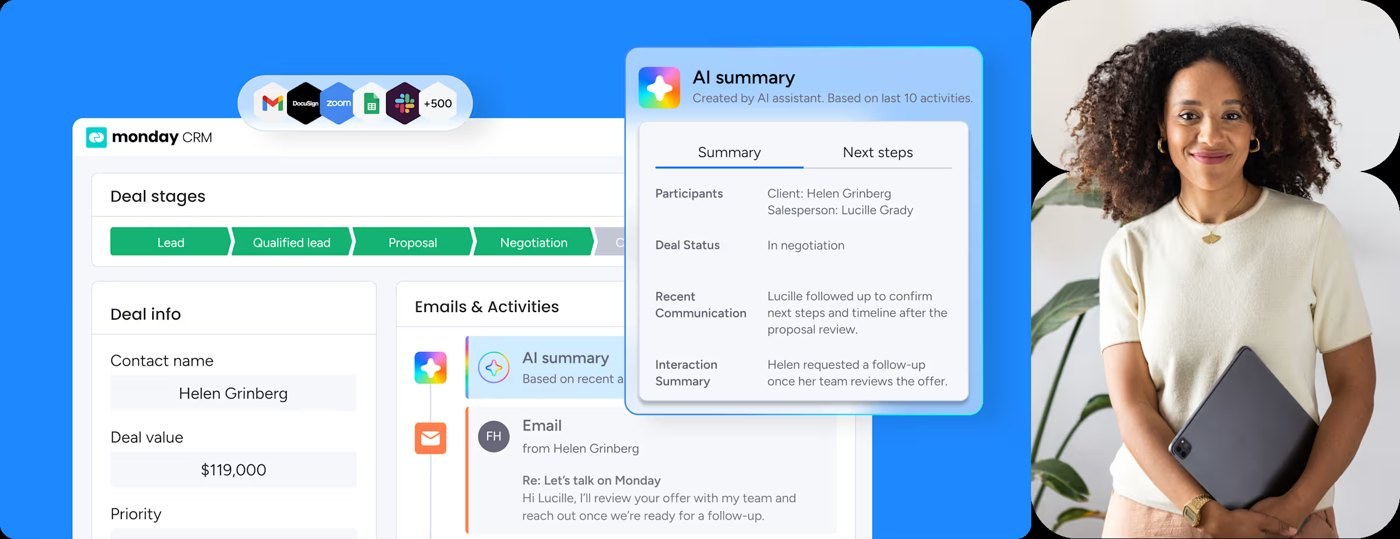
Screenshots sourced from monday.com's publicly available materials and shown for identification and review purposes. Interface shown may differ from the current release.
Automation & reporting
Automate follow-ups and track performance on dashboards
No-code automations can assign owners, send reminders and move deals forward based on rules a team sets up itself. Dashboards pull together deal, forecast and activity data so managers can see pipeline status without building separate reports.
- No-code automation rules
- Dashboards for deals and forecasts
- Integrations with other work tools

Screenshots sourced from monday.com's publicly available materials and shown for identification and review purposes. Interface shown may differ from the current release.
Pricing
How much does monday.com cost?
monday CRM is offered in tiered plans structured per seat per month, typically billed annually, with feature and automation limits increasing at higher tiers.
Get PricingBasic CRM
Core contact and deal management for small sales teams.
Standard CRM
Adds automations, integrations and forecasting features.
Pro CRM
Advanced automations, analytics and sales tracking for larger teams.
Enterprise
Advanced governance, security and support for larger organizations.
Across public reviews, monday CRM is generally seen as good value for its flexibility, though some buyers note that costs can add up as more seats and automations are needed.
Plan details is subject to change.
Who it's for
Who is monday.com for?
Use cases
Common ways teams use monday.com
Building a custom sales pipeline
Set up boards with stages, fields and views tailored to a specific sales process rather than a fixed template.
Automating routine follow-ups
Use no-code automation rules to assign owners, send reminders and move deals forward automatically.
Tracking pipeline performance
Build dashboards that combine deal, forecast and activity data for a real-time view of sales status.
Connecting sales with other teams
Keep sales boards alongside project and operations boards built on the same monday platform.
What users say
Aggregated from public reviews, sentiment toward monday CRM is largely favourable: users value the visual boards, ease of customization and no-code automation builder. The most common criticisms are that plan details can rise as teams add seats and automations, and that some advanced sales-specific features feel less mature than dedicated CRM competitors. Reviewers are most often sales managers, small business owners and operations staff.
Features
monday.com features
Capabilities listed on the official site, summarised in our own words. Exact availability varies by plan.
Customizable pipeline boards
Set up boards with stages, columns and views matched to a team's own sales process.
No-code automations
Create automation rules for assignments, reminders and stage changes without code.
Dashboards and reporting
Combine deal, forecast and activity data into real-time dashboards.
Contact and account management
Track leads, contacts, deals and accounts within the same workspace.
Integrations
Connect with common business, email and communication tools.
Pros & cons
monday.com pros and cons
Pros
- Highly customizable pipelines and boards
- Easy to build no-code automations
- Visual, flexible interface
- Integrates with monday's wider work platform
- Suitable for varied team sizes
Cons
- Costs can rise with more seats and automations
- Some advanced sales features are less specialized
- Setup requires configuration time
- Learning curve for building automations
FAQ
Common questions about monday.com
Request a demo
Share a few details and we'll help arrange a monday.com walkthrough for your workflow.
Software Finder is an independent software marketplace, not monday.com, and not affiliated with or endorsed by them.
By submitting, you agree to Software Finder's Terms of Service and Privacy Policy and consent to be contacted by Software Finder and one or more matchedsoftware vendors (which may include monday.com) about your request. You can opt out at any time.
Next step
Still comparing options? See monday.com in action.
Software Finder helps you gather the information that actually drives a software decision, a real walkthrough of monday.com and a clear view of how it compares to similar platforms.
- See monday.com in a live walkthrough
- Connect with the right team
- Compare against similar CRM platforms
- Independent guidance